What we do
Artificial grass installation in Miami-Dade and Broward
We install artificial grass across five kinds of work, with the same technique underneath and very different demands on top. Pick yours and you will see what gets checked, what drives the price, and real work of that type.
Residential artificial grass
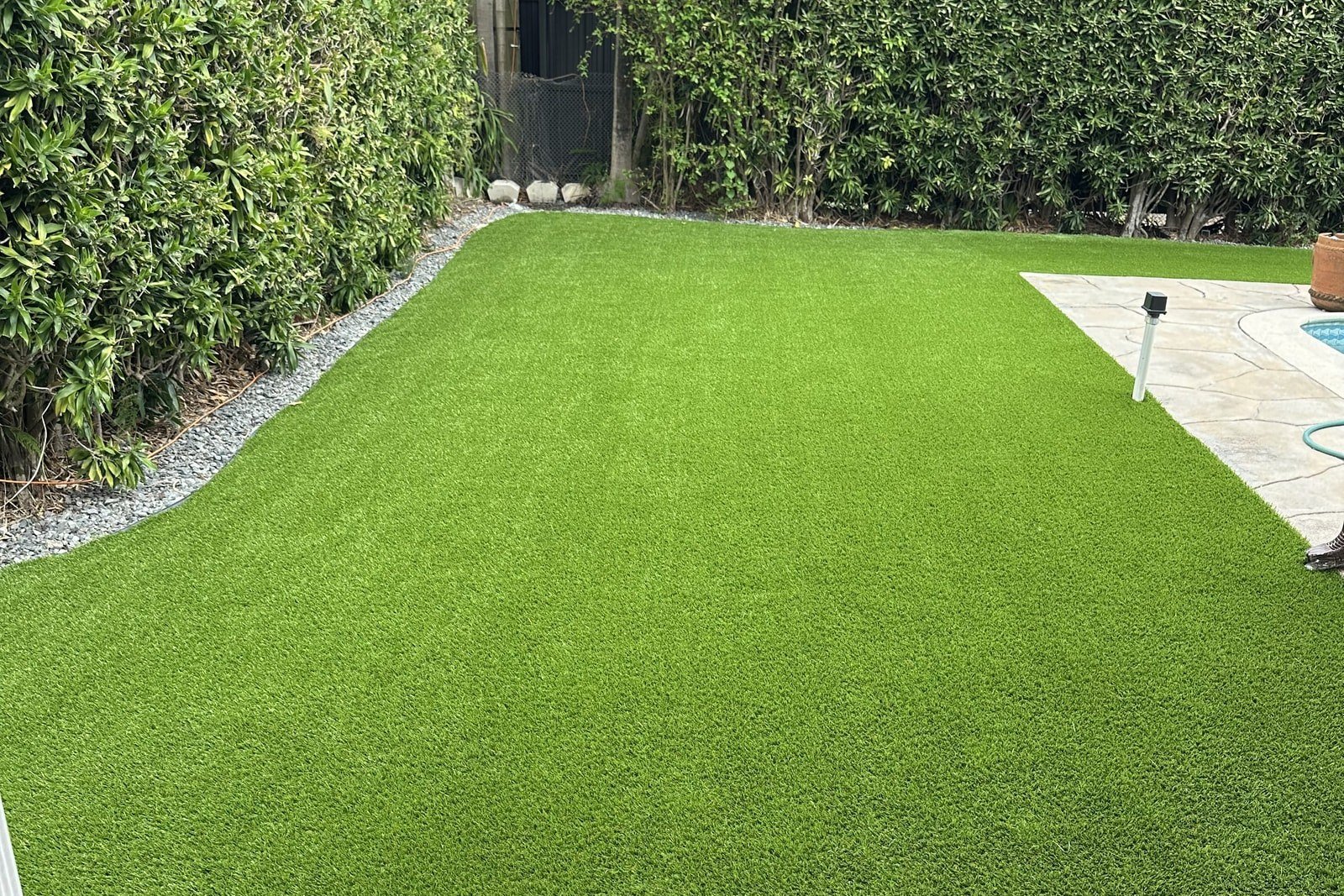
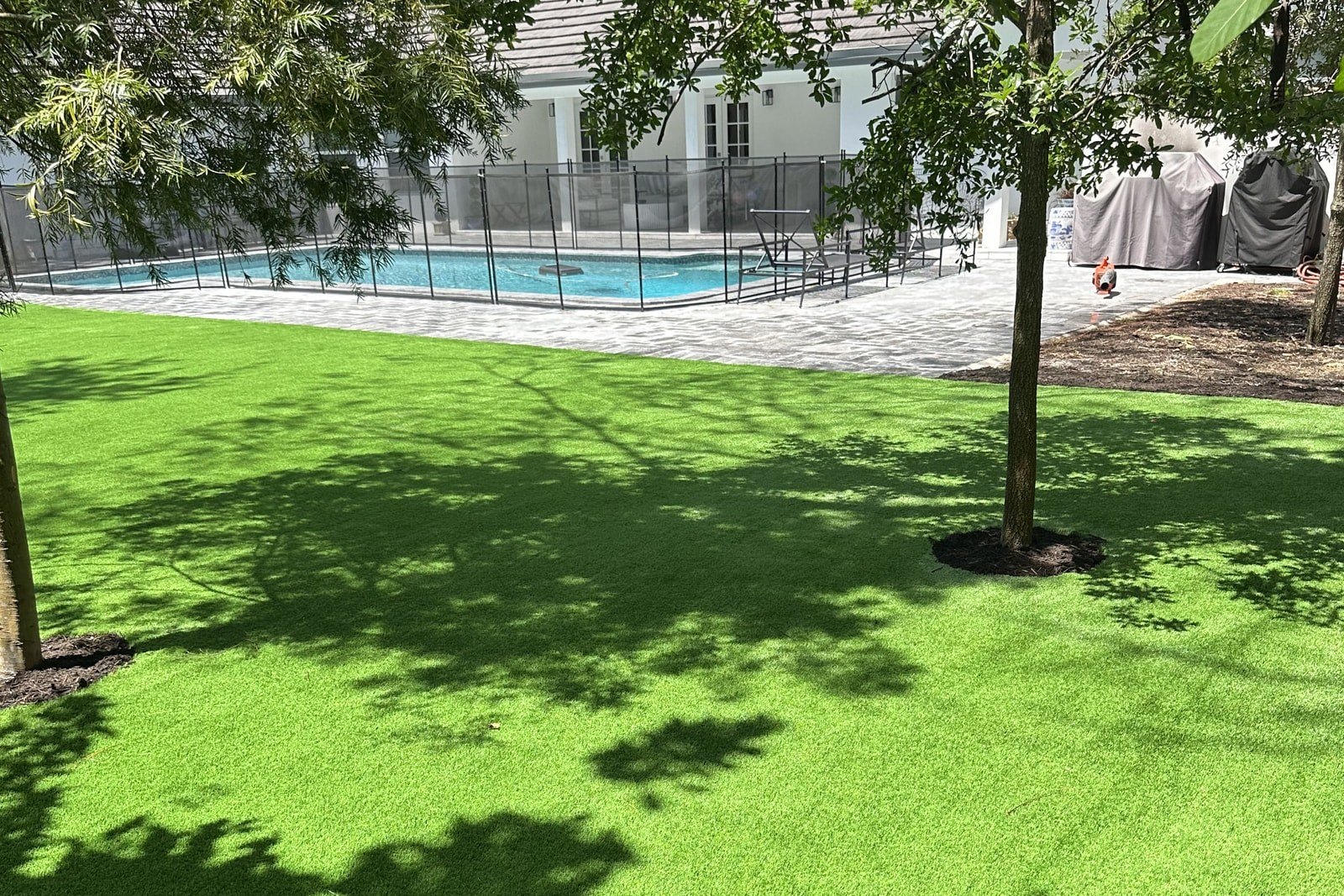
Homes and townhousesThe front yard, the back, the strip around the pool, or that corner where nothing ever grew because it never gets sun. It goes in once, it sits flat, and it looks the same in August as it does in January.
Why it makes particular sense in Miami
Miami-Dade allows watering two days a week. Natural grass at this latitude needs more than that to stay green, so most yards in the city live in a standoff: either the rule gets stretched, or you live with the burnt look of July.
Artificial grass takes that problem off the table. No watering, no mowing, and no dependence on rain or shade. In a yard that actually gets used (kids, dogs, a pool) it solves the other half too: no mud after the afternoon downpour and no dirt tracked into the house.
Shade, pool edges and the corners that never work
The spots where natural grass never takes hold are always the same ones: under a large tree, in the narrow run between the house and the fence, and along the strip the house keeps in shade all afternoon. Those places are not short on water, they are short on light, and light is not negotiable.
The pool edge is its own case. Splash-out carries chlorine or salt depending on the system, and that burns natural grass and washes the soil away with it. Artificial grass does not react to either, and finished properly against the deck it stops that bare strip that turns to mud every time somebody climbs out.
With dogs: the smell does not come from the product
This is the question we get most. Odour shows up when liquid stays in instead of draining out: a base that does not let water through, an infill that holds it, or an install with no fall. Over a properly compacted draining base, urine passes through the fibre the same way rainwater does and leaves underneath.
The rest is ordinary upkeep: solids get picked up like in any yard, and a pass with the hose now and then handles the rest. If there is a dog in the house, say so during the visit. It changes which infill makes sense and how much fall the base gets.
What decides whether it still looks right in three years
Not the grass. What sits underneath it. The part nobody sees (stripping out what was there, grading, and compacting the draining base) is what decides whether the yard stays flat or starts to dip and wrinkle. It is also the part that gets cut when somebody quotes far below everyone else.
The other half is the finish: every piece of fibre laid in the same direction (otherwise, with the sun low, you see colour patches where the grain changes), seams lined up, and edges anchored. That is the difference between a yard that reads as grass and one that reads as a rug someone put down.
Playground artificial turf
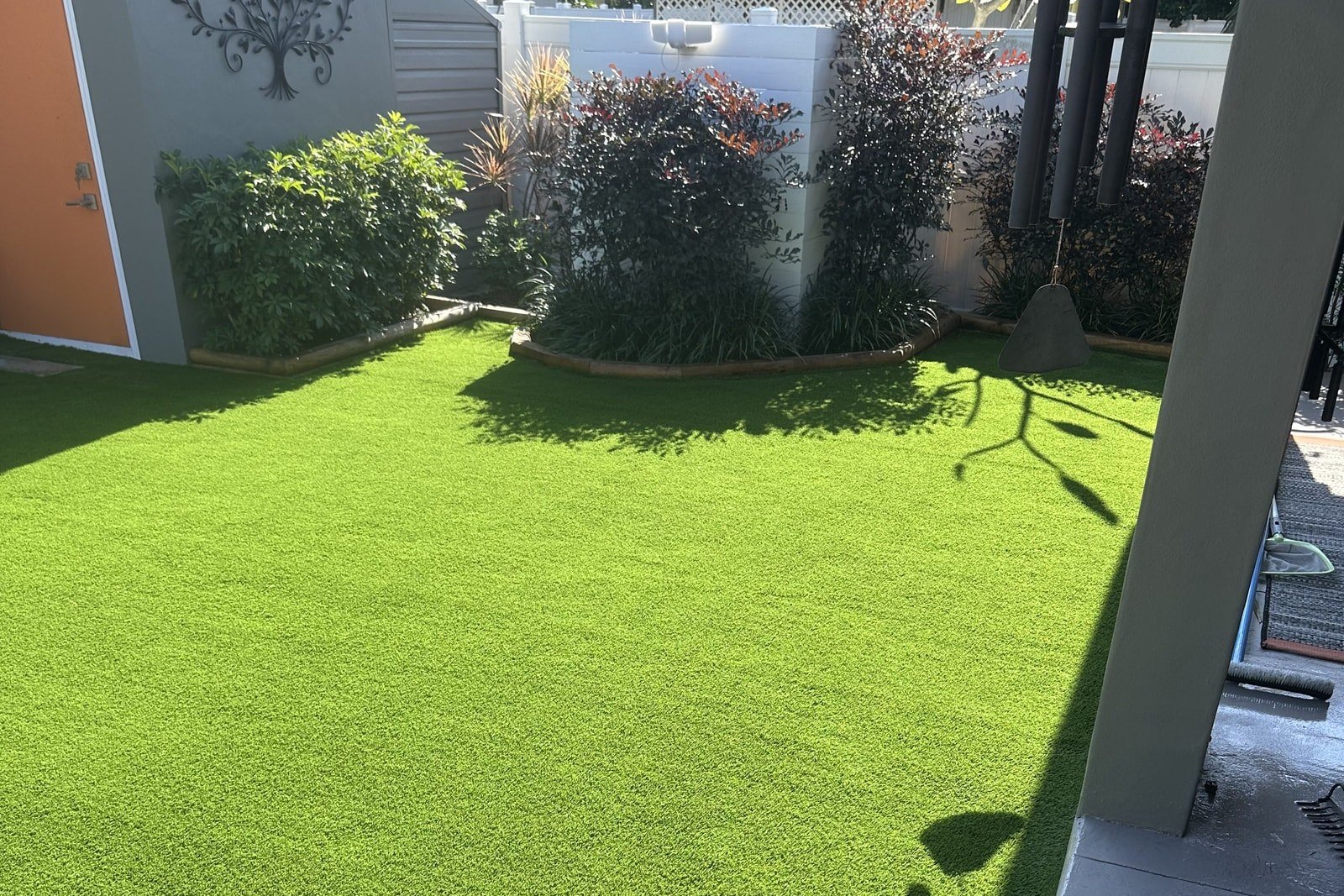
Schools, condos and homesA surface that takes running, falling and full sun all day, does not turn to mud when it rains, and does not send kids home covered in dirt. This is where artificial turf solves the most problems at once.
The problem is not the equipment, it is the ground under it
A Florida play area swings between two extremes in a single day: the afternoon downpour turns it to mud and the sun afterwards bakes it hard and bare. Between the two, the high-traffic spots (under the swings, at the bottom of the slide) are down to dirt within a couple of months.
No natural grass survives that, and sand or mulch solves the fall but migrates, sticks to clothes and ends up inside the building. A continuous turf surface stays where it was put and looks the same in September as it did in May.
Where there is fall height, something else goes underneath
This is what separates a play area from an ordinary yard, and it is worth stating plainly: turf on its own is not a shock-absorbing surface. Where there is equipment with height, the cushioning comes from the layer underneath, and its thickness is set by the fall height of that specific equipment.
So it is not a catalogue choice, it is a measurement: we look at the equipment you have or plan to install, the height a child can fall from, and that determines what goes below. If yours needs it, we say so at the visit and it goes in the written estimate with its cost.
If the area is flat ground (a running space, a daycare yard with no tall structures) none of that is needed and none of it gets charged.
Hygiene, which is every school’s second question
A play surface gets cleaned because it gets dirty: food, drinks, and whatever the kids bring with them. Turf rinses down with a hose and drains through, so it does not pond like a continuous rubber surface or hold dirt the way sand does.
What makes that work is drainage again: if the water has nowhere to go, no amount of cleaning helps. Which is why on a school yard the fall and the base get worked out before anything else.
The largest job we have delivered was exactly this
The company’s largest project is a 22,800 sq ft school yard, posted on its own Instagram account in August 2025. It is in the gallery below, along with a corridor at the same school.
That is a job you can open and look at, not a brochure figure. And on work that size you are hiring more than the surface. The job has to be sequenced around the school calendar so it does not leave the yard half finished on a Monday morning.
Synthetic putting greens
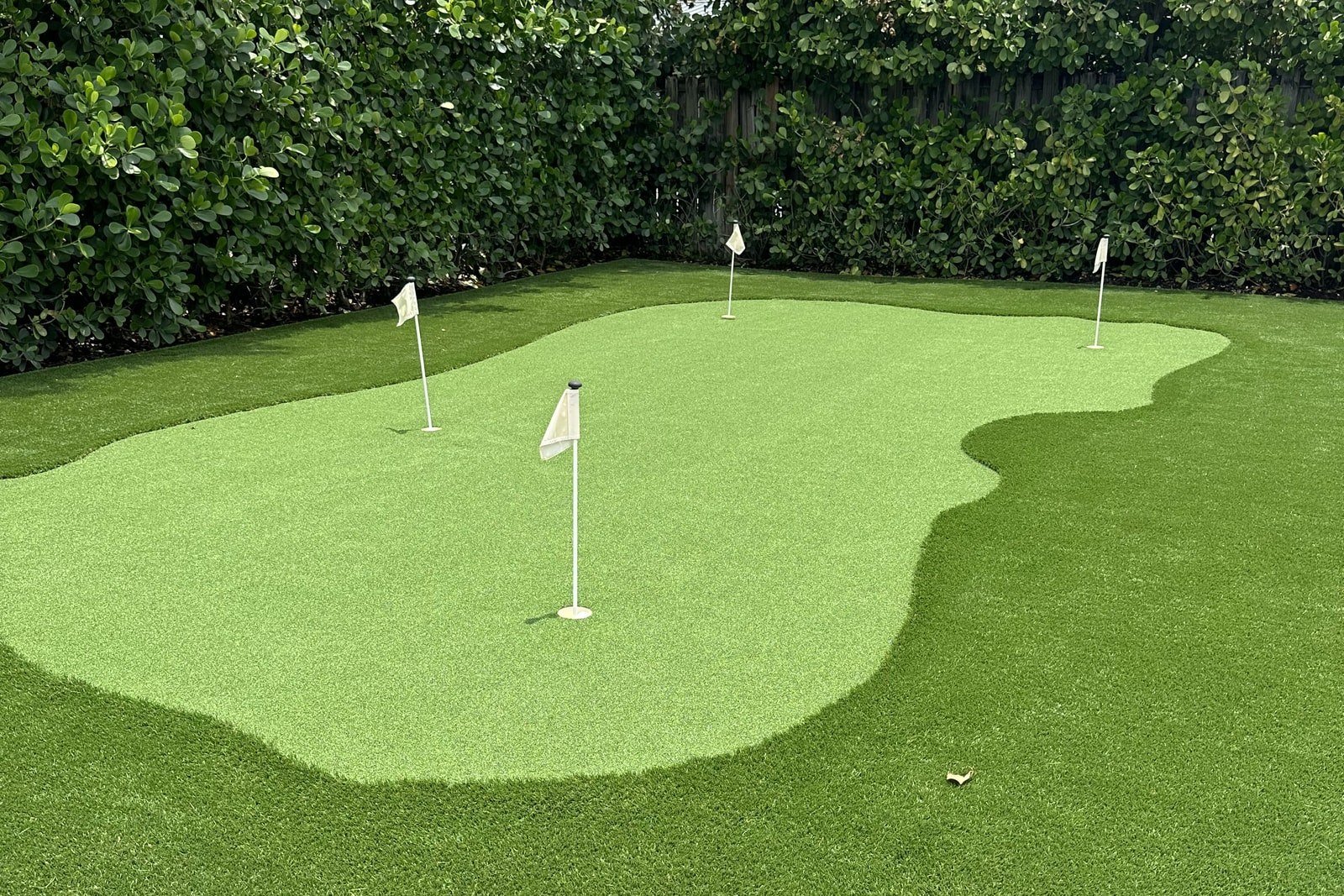
Golfers and businessesYour own green in the backyard, with a true roll and the holes where you want them. Full mini golf courses too, for hotels, communities and commercial spaces.
A green takes more than shorter grass
A putting surface uses a much shorter and much denser fibre than a yard, because the ball has to roll across it instead of sinking into it. But what really decides how it rolls is the base underneath.
A yard base is compacted so it will not settle. A green base is compacted and then shaped: it is built to the exact contour the finished surface will have, because any waviness left underneath shows up in the line of the putt. It is the slow part of the job, and the part that cannot be fixed afterwards.
Speed is tuned, it does not come out of a box
The roll on a synthetic green depends on how much sand infill goes in and how the fibre is brushed. More infill and a well-groomed fibre gives a faster ball; less gives a slower one. It gets set at handover and it can be adjusted again later.
Which is why it helps to say up front how you plan to use it. A green for practising putting seriously is not the same as a play area for the family and guests, the speed you want is different and so is the setup.
Contours, fringe and how many holes
A flat one-hole green gets boring in a week. What makes one usable every day is the contouring: two or three gentle breaks that force you to read the putt differently depending on where you play from.
Around it you can run a strip of longer fibre as a fringe, in a different tone, so you can practise the short shot that runs on. That is a material change at the edge, and it has to be decided before installation because it changes how the pieces are cut.
How many holes is set by the space, not by a catalogue. At the visit we measure and tell you honestly how many fit sensibly: five holes where two belong makes a worse green, not a better one.
Mini golf for businesses
The same material and the same base build a full mini golf course at a hotel, a community or a commercial space. What changes is the design (obstacles, routing, edges) and the coordination, because it usually means working around a space that stays open to the public.
If it is for a business, tell us the space and how it will be used and we will look at it on site.
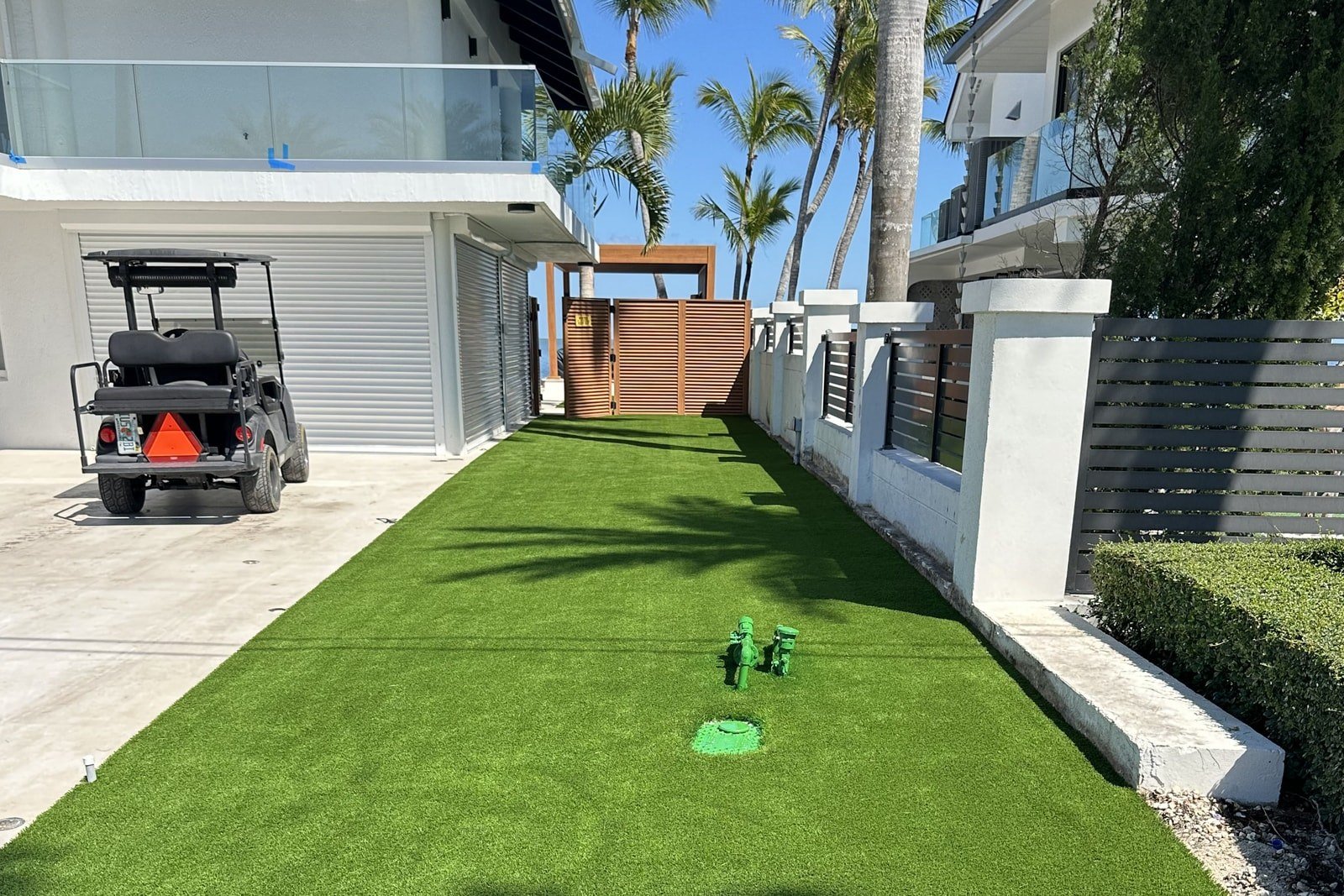
Driveway and walkway artificial grass
Driveways and entriesThe green strips between driveway pavers, the path from the gate to the front door, and the border between paving and planting. It is the detail that changes the whole front of a house, and it asks for nothing back.
The part of the house everyone sees and nobody waters
The front is the first thing anyone sees, and it is almost always the worst kept part of the property: narrow strips, constantly walked on, no shade, and the hardest place on the lot to irrigate. No natural grass survives a Miami summer in a twelve-inch band between two slabs.
With artificial grass those strips stay green with no effort, and the contrast against the concrete is exactly what makes a driveway read as looked-after. It is one of the smallest jobs we do and one of the ones that changes a house the most.
Yes, you can drive on it. What lifts it is something else
The question is always whether the car’s weight ruins it, and weight is not the problem. Grass in a driveway strip takes a car driving over it, provided the base was compacted the way a driveway base gets compacted, which is more than a yard base.
What does lift a strip is a badly resolved edge. If the finish against the concrete is not anchored, a tyre turning on top of it eventually catches the edge and peels it. Which is why on this job half the craft is in the edge: how it is cut, what it is fixed to, and what height it sits at relative to the slab.
Height matters more than it sounds: if the grass sits proud of the concrete, the edge is exposed and that is what catches. Flush, it does not.
Walkways and side runs
The same work covers the path from the gate to the door, the narrow run between house and fence, and the joints between patio slabs. Constant foot traffic, partial shade and narrow width, the three conditions that kill natural grass all at once.
On a path there is a second benefit: no mud. That trodden strip of dirt beside the pavers is what ends up inside the house every time it rains.
Oil stains and cleaning
It is a driveway, so sooner or later something drips. Spills sit on the surface of the fibre rather than soaking in, so they clean up at the time with water and a mild soap. What you do not want is to let it dry for weeks and then attack it with solvent.
The rest of the upkeep is blowing leaves off now and then, exactly as you already do with the paving.

Commercial artificial turf
Contractors and propertiesLarge surfaces, with deadlines, and with other trades working alongside. Our largest delivered project was 22,800 sq ft: a complete school yard.
What changes when the job is large
The technique is the same as a residential yard. Everything around it is different. On a commercial job the work has a date that depends on other people, a space that is often still in use, and access that has to be shared with other trades.
So on a project like this the conversation does not start with square footage. It starts with when work can happen, which areas have to stay usable meanwhile, and who has to be coordinated with on site.
The proof we can actually show
The company delivered a 22,800 sq ft school yard, posted to its Instagram on 13 August 2025, and a 4,000 sq ft waterfront transformation posted on 26 March 2026. Both can be opened and checked on its Instagram; the school yard is also in the gallery on this site.
We quote those two figures and no others because those are the two anyone can open and check. This site does not count years in business or number of projects. It shows work you can look at.
Large surface means drainage has to be designed
On a residential yard water mostly sorts itself out. Across twenty thousand square feet it does not: water travels long distances, collects wherever there is a tenth of a percent of fall going the wrong way, and finds any low point left unresolved.
That is the real work on a large job, and it is invisible in the handover photo. It gets solved beforehand, by shaping the base to the right falls and checking them with water rather than by eye.
Where this fits
Schools and daycares, condo courtyards and common areas, terraces and green areas at commercial units, rental properties, and new build handing over finished landscaping. Waterfront properties too, where salt takes natural grass apart.
If you are a contractor, condo association or property manager and you need a number to budget against, say so and we will give you one with the measuring done, not estimated from above.
How we work
What is the same across all five
The use changes, the finish changes, and so does what has to be solved first. What does not change is the order of the work, or the part that decides whether it lasts: the base.
- 01
You reach out and we come look
WhatsApp or a phone call. We come out, measure the actual area and talk through what you want. The estimate is free and commits you to nothing.
- 02
You get the price in writing
With the square footage, the turf type and what’s included. If there’s anything about your city permit or your HOA we should check first, you hear it then, not later.
- 03
We prepare the base
We remove what was there, grade it, and compact a draining base. This is the part nobody sees and the part that decides whether it’s still perfect in three years. This is exactly where cheap installations fail.
- 04
We install the turf
Rolled out, every piece with the fiber running the same direction (otherwise you see mismatched patches in low sun), cut to fit, seamed and anchored at the edges.
- 05
Infill, brush and clean up
Infill settles the fiber and keeps it standing up. We brush it out, haul everything away and hand it over ready to walk on. We don’t leave a job half done.
Not sure which one yours is?
Tell us and we will tell you. We come out, measure it, and give you the price in writing. Free.